Who is behind the AI safety backlash?
Following a viral resignation, the backlash against AI safety was sudden and swift. Various signs suggest an industry push is supporting it.
Tyler Johnston
·

Recently, a chorus of Twitter users has begun aggressively criticizing ex-employees, organizations, and public figures who warn about AI. We’ve seen long Twitter threads “exposing” them, tabloid pieces that look as if they may have been planted, and frequent claims that the best way to approach the technology is to leave it unregulated, unmonitored, and unencumbered. These accounts have accused those warning about AI of running a bought-and-paid-for influence campaign to promote left-wing or globalist agendas, entrench power for OpenAI and Anthropic, or otherwise mislead the public.
But to a large extent, it is industry insiders and political groups promoting and signal-boosting this narrative, with their own less-than-pure motivations for convincing the public that AI is best left unregulated. These arguments have gained sway with multiple politicians, and even the White House itself. At its core, their contention is that following the money will lead one to conclude that AI safety concerns are not grounded in reality, but are merely part of a sophisticated “psyop,” perhaps run on behalf of Big Tech companies.
To be clear, there are indeed a large number of well-funded groups trying hard to get their message about AI risk in front of the public, and any powerful interest group deserves skepticism. But relatively little attention has been paid to just how much of this counternarrative has this exact quality: a concerted messaging campaign pushed heavily by figures closely linked to the AI industry and its political front groups. In other words, the accusation fits the accusers just as much as it fits their targets.
This broader tension between AI safety groups and anti-regulation political groups has been simmering for a while, but as far as I can tell, it came to a head on Sept. 8, when former Anthropic employee Jacob Coxon announced his resignation with a tweet thread that went mega-viral (173 million views and counting). Since then, media outlets have run weeks of serious coverage of AI risks, and a major preference cascade in support of AI safety has begun. Polling from Blue Rose Research suggests AI salience increased among the public more in a week than in the past year, and many lawmakers have begun calling for regulation. The AI lab leaders themselves have also spoken out, with Dario Amodei, Sam Altman, and Elon Musk endorsing the need to develop means of “pacing” frontier AI development to make sure their models don’t spiral out of control as AI begins to develop itself. More than 1,000 lab employees endorsed the same idea in July.
But almost immediately after this wave of concern took hold, a new backlash campaign began: various figures from the tech right started working night and day to criticize AI safety advocates — calling them doomers, calling them woke, connecting them to effective altruism, searching for other reputational vulnerabilities, and generally trying to conflate the idea that “AI should be regulated” with the idea of extremism and partisan politics. In many ways, this effort is working. Even the White House has started taking part, retweeting a Pentagon account’s declaration that America wants “Americanism, not effective altruism” around the time President Donald Trump himself posted that fears of AI “taking over the World” are “a HOAX.”
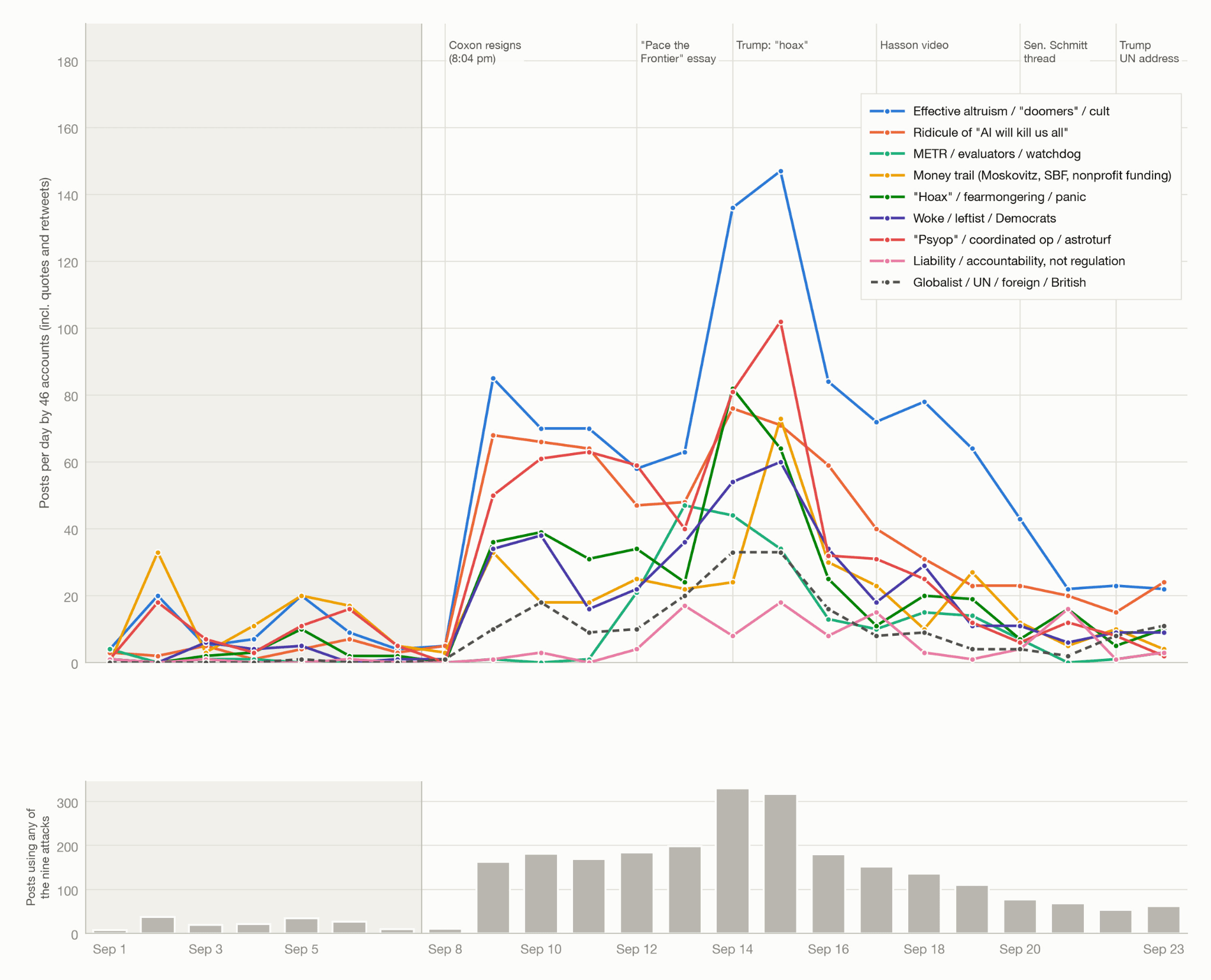
Each colored line shows the frequency of tweets fitting the relevant line of attack from the dozens of accounts analyzed.
I spent the last few weeks watching this backlash closely, collecting much of the online activity and mapping it out to answer: Who is primarily responsible for pushing this narrative? Is this earnest (and well-deserved) skepticism of parts of the well-funded philanthropic ecosystem that supports various AI safety organizations? Or is this a coordinated campaign, connected to the AI industry, its super PACs, and even the White House itself, trying to squash the prospect of regulation by writing off concerns about AI?
For this analysis, I focused primarily on Twitter activity, which has long been central to AI discourse. With the help of AI tools, I used targeted keyword searches to collect over 10,000 tweets and to identify dozens of accounts that were involved in promoting this narrative. I then sorted their posts into a taxonomy of nine lines of attack. These included attacking effective altruism as a “doomer cult,” connecting AI safety to the “woke left,” criticizing the organization METR, and arguing that existing liability laws can substitute for regulation. Various versions of these arguments had been simmering in the discourse for a long time, but each spiked immediately after Coxon’s resignation (and, relatedly, after Amodei’s “We Must Pace the Frontier” essay, which likely motivated the focus on groups like METR).
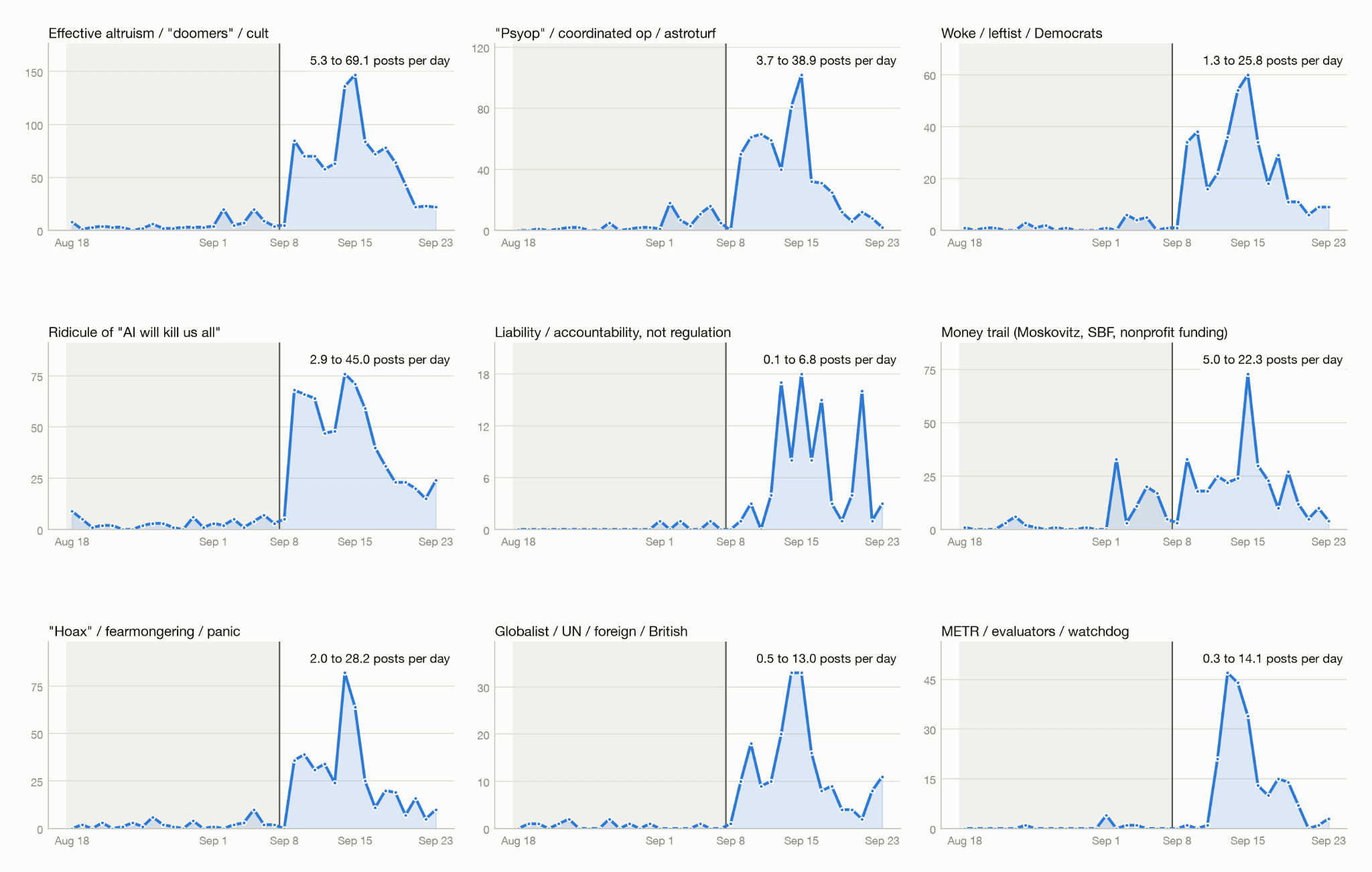
Each line shows the frequency of tweets fitting the relevant line of attack from the dozens of accounts analyzed.
Which accounts were most vocal in promoting this narrative? It seems the past few weeks’ discourse was in large part generated and signal-boosted by an overlapping web of accounts tied to the White House, the AI industry, and political operatives working on their behalf. These included the industry-affiliated political advocacy groups Leading The Future and Innovation Council Action, the anti-regulation dark-money group Alliance For The Future, the venture capital firm Andreessen Horowitz (a16z) — which funds some of that political advocacy — as well as the White House, the All-In podcast (with ties to the White House and to Innovation Council Action), and a handful of other commentators with uncertain links to the industry. The backlash also drew heavy posting from commentators with no known industry ties, such as Brian Roemmele and Mike Adams (the “Health Ranger”), and even a few on the left, like Jim Stewartson, who dismiss safety fears as industry hype.
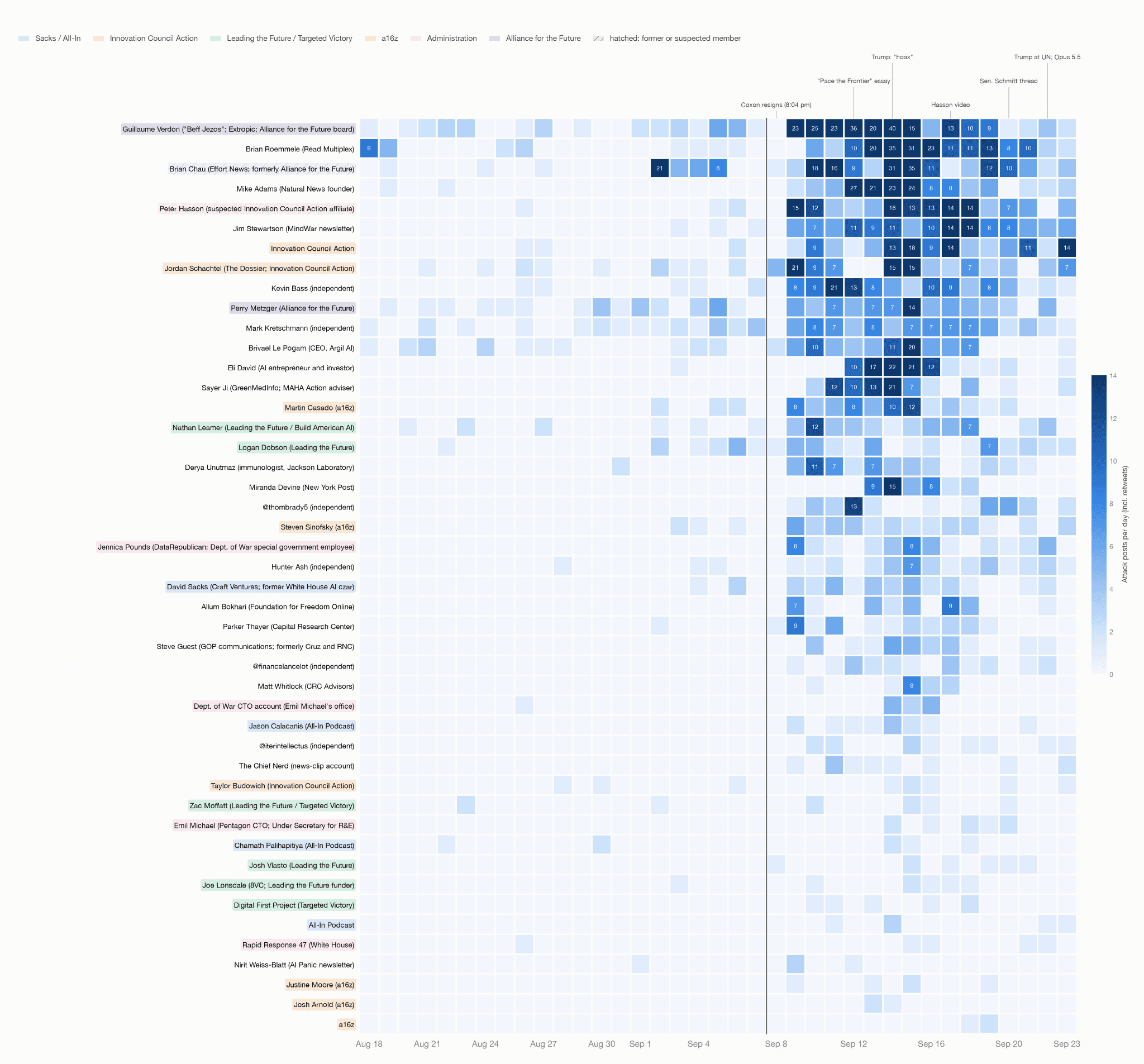
The heat map shows how often each account posted about the identified topics on each day.
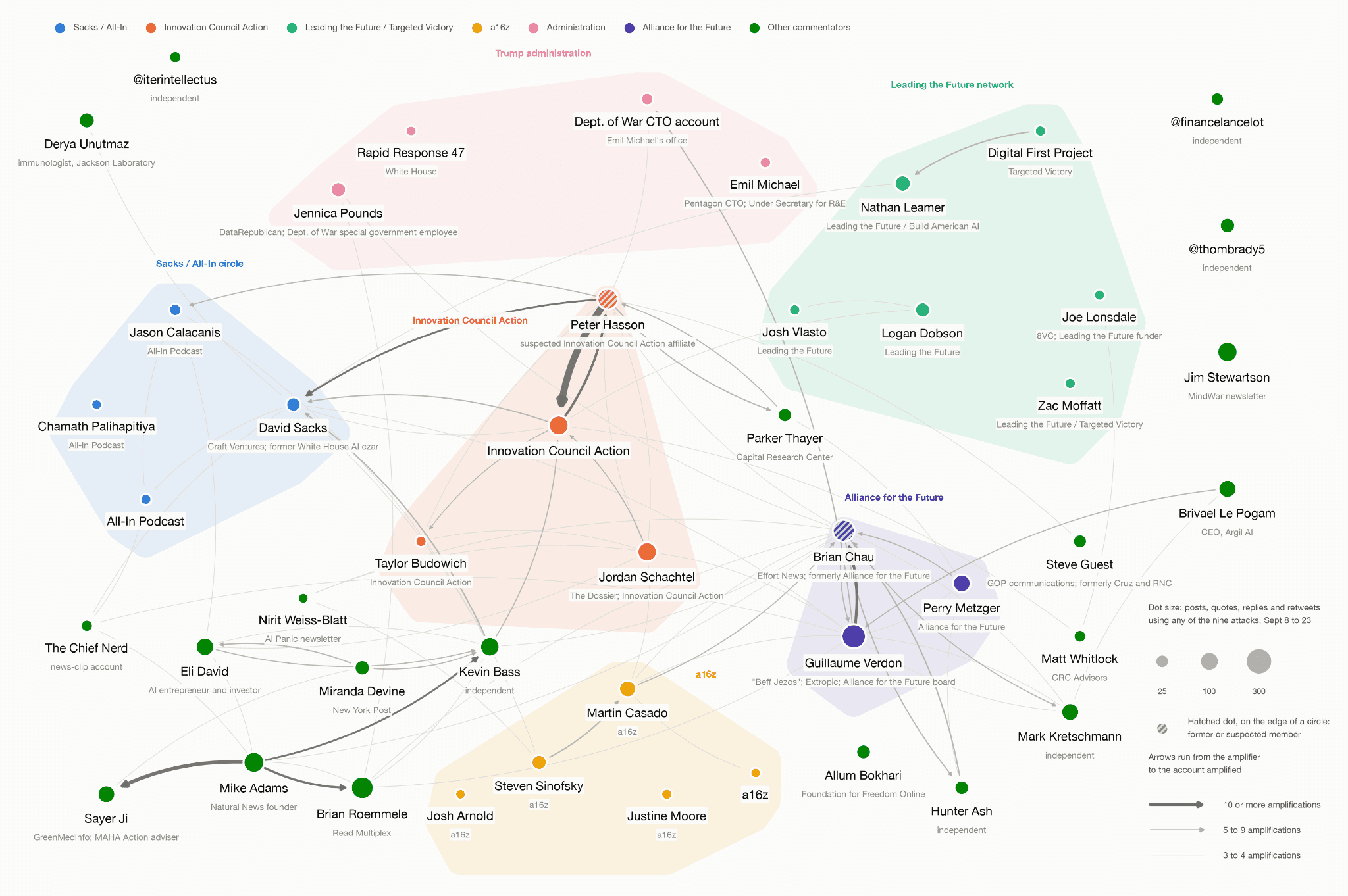
Dot size represents each account’s posting volume on the identified topics, while arrow size represents the magnitude of retweets and quote tweets between accounts.
At the center of this campaign was Innovation Council Action. It is an industry group, announced earlier this year, that opposes regulation, with plans to spend at least $100 million influencing elections. We don’t know who funds Innovation Council Action — it is presently a dark-money group that doesn’t need to disclose this information. However, when I wrote about it in July (breaking the story that it appeared to be paying right-wing influencers to promote its messages), I speculated, based on its priorities and posting habits, that the most likely funders were a16z or Nvidia. From its inception, the group has explicitly aligned with David Sacks and the White House. Beyond promoting the data center buildout, its main focus has been fighting regulation, those it perceives as doomers, and Anthropic in particular.
It’s hard to overstate just how dominant a priority this messaging campaign has become for Innovation Council Action. Including retweets, its account made only 45 posts in July and 188 in August, but has already made 453 in September as of Sept. 24. More than half of its posts since Sept. 8 were about the AI safety fight. In the week before Coxon resigned, the account mentioned “doomers” once and effective altruism not at all. In the two weeks after, it posted about effective altruism or “doomers” 29 times. It clipped Trump’s post calling AI safety a “hoax” around 10 minutes after it went live, shared clips of Nvidia CEO Jensen Huang with the caption “AI doomers should be held accountable,” accused Amodei of using the same tactics as Sam Bankman-Fried, ridiculed a CNN guest, and even produced and released at least two TV-style video advertisements attacking “doomers.”
And that is just counting the official account. Another major poster in this messaging campaign has been Jordan Schachtel. Schachtel is a political consultant who was once recorded on a secret camera admitting to running undisclosed social media campaigns on behalf of The Israel Project. He now publishes a Substack, The Dossier, that advertises “independent investigative reporting,” which has mostly focused on AI and doomers in recent months, seemingly on behalf of Innovation Council Action. In fact, his first Substack piece attacking the AI safety movement, which he described as “thought control,” appeared on Feb. 26, two days after Innovation Council Action created its Twitter account. This doesn’t seem like a coincidence. He previously listed Innovation Council Action on his LinkedIn and has been identified in the media as the group’s senior policy adviser. All signs suggest that he is producing content as part of his work with the group (although he once denied it in a suspiciously now-deleted tweet).
Schachtel was among the first to join this campaign. At 9:17 p.m. on Sept. 8, 70 minutes after Coxon’s resignation thread was posted, he was already framing it as a plot to “slow down AI” that would hand the lead to China. Two hours later, he posted: “We are dealing with a doomsday cult. They want to control every lever of our society.” Between Sept. 8 and Sept. 23, inclusive of retweets, he posted 192 times. Of those, 104 hit at least one of the anti-safety narrative threads I identified, and 55 of them were specifically about effective altruism or “doomers.”
Another major poster is Peter Hasson, who I suspect is working closely with Innovation Council Action, although he has not disclosed any affiliation. Hasson left the Washington Free Beacon this summer; his last byline there was July 6, and three days later, he followed Innovation Council Action on Twitter. His bio reads “Now: Doing things.” Among the things he has been doing is signal-boosting Innovation Council Action. Between Sept. 8 and Sept. 23, and inclusive of retweets, his account posted over 500 times. He retweeted Innovation Council Action more than any other account, by a factor of five. At least 52 of those retweets were about the AI safety fight, and at least nine of those came within a minute of the original. The organization retweeted him back 16 times, and it did so within three minutes on three separate posts.
On Sept. 17, Hasson posted a professionally produced, TV advertisement-style video with the caption: “Effective Altruism is a cult. America must reject it.” The video has been viewed about 163,000 times. If you slow down the video and compare its editing style with a separate, professionally produced advertisement shared by Innovation Council Action, you’ll spot several similarities (including the same sound and transition effects). However, only the video posted on Innovation Council Action’s main account included a disclaimer that the group paid for it, which (to its credit) has appeared in most of its past media.
Innovation Council Action is run by Taylor Budowich, the former White House deputy chief of staff and longtime Trump adviser. He, of course, participated in the Twitter messaging campaign I identified, echoing Schachtel and the organization’s main account in its attack on Anthropic.
Axios also reported on Sept. 24 that a (100% AI-generated) memo with similar talking points — attacking Anthropic and connecting it to effective altruism and left-wing ideas — was circulating in the White House after being “penned by a Trump political adviser,” which could be anyone, but would describe Budowich well.
It’s possible that Innovation Council Action and its affiliates such as Budowich were also responsible for the influx in coverage from the New York Post about “doomers,” effective altruism, and Anthropic, which kicked into high gear during this same time period and has repeatedly cited anonymous sources “close to the White House” or “familiar with the White House’s thinking.” The Post’s recent stories have closely mirrored the messages these accounts are sharing on Twitter. When NY Post columnist Miranda Devine shared the publication’s Sept. 15 story calling METR Amodei’s “handpicked AI watchdog” with “deep ties” to effective altruism, Hasson retweeted it 39 minutes later, and Innovation Council Action followed one minute after him. Sacks himself retweeted the Post’s own version within the hour. On Sept. 16, the Post ran a story on an AI safety figure’s sex life. Hasson retweeted it seven minutes after it went up. On Sept. 19, the Post claimed the labs had “oversold AI security breaches,” and Hasson and Innovation Council Action both retweeted it that day.
Innovation Council Action wasn’t the only industry group pushing these narratives. Various affiliates of Leading The Future, the $140 million super PAC funded by executives at OpenAI and a16z, also promoted these attacks.
Other major names participating include Brian Chau, Perry Metzger, and Guillaume Verdon, all of whom are or have been affiliated with Alliance For The Future — a 501(c)(4) advocacy group that has taken industry-friendly positions and opposed regulation, although it hasn’t disclosed its donors and the nature of its funding is unclear.
In any case, none of this means the people warning about AI are above scrutiny. There is big money supporting many of the groups raising alarms, much of it from a small number of wealthy donors. But on the other side, the AI industry is spending hundreds of millions of dollars on political advocacy, spending hundreds of billions of dollars building this technology, and has trillions of dollars riding on its continued growth. These companies and investors have every reason to want the public, and Washington, to stop worrying about what could go wrong. Skepticism is warranted all around; it just has to be applied evenly.
That’s what makes Innovation Council Action’s role in this backlash so striking. For the past few weeks, a group with plans to spend at least $100 million, run by a former White House deputy chief of staff, has spent its days telling Americans that warnings about AI are merely a well-funded, coordinated campaign. It’s done this through hundreds of social media posts, professional TV advertisement-style videos, and potentially even planted stories advancing its cause. By its own standards, it’s acting just like the thing it’s warning about.
But both sides trading accusations about who is paying whom can get you only so far. At some point, the conversation must return to the actual issues and the merits of the arguments on either side: What should we make of AI progress? How dangerous is it really? What would a sane policy response to all of this look like?
The sooner the discourse can return to focusing on these core questions, the better.
Recently, a chorus of Twitter users has begun aggressively criticizing ex-employees, organizations, and public figures who warn about AI. We’ve seen long Twitter threads “exposing” them, tabloid pieces that look as if they may have been planted, and frequent claims that the best way to approach the technology is to leave it unregulated, unmonitored, and unencumbered. These accounts have accused those warning about AI of running a bought-and-paid-for influence campaign to promote left-wing or globalist agendas, entrench power for OpenAI and Anthropic, or otherwise mislead the public.
But to a large extent, it is industry insiders and political groups promoting and signal-boosting this narrative, with their own less-than-pure motivations for convincing the public that AI is best left unregulated. These arguments have gained sway with multiple politicians, and even the White House itself. At its core, their contention is that following the money will lead one to conclude that AI safety concerns are not grounded in reality, but are merely part of a sophisticated “psyop,” perhaps run on behalf of Big Tech companies.
To be clear, there are indeed a large number of well-funded groups trying hard to get their message about AI risk in front of the public, and any powerful interest group deserves skepticism. But relatively little attention has been paid to just how much of this counternarrative has this exact quality: a concerted messaging campaign pushed heavily by figures closely linked to the AI industry and its political front groups. In other words, the accusation fits the accusers just as much as it fits their targets.
This broader tension between AI safety groups and anti-regulation political groups has been simmering for a while, but as far as I can tell, it came to a head on Sept. 8, when former Anthropic employee Jacob Coxon announced his resignation with a tweet thread that went mega-viral (173 million views and counting). Since then, media outlets have run weeks of serious coverage of AI risks, and a major preference cascade in support of AI safety has begun. Polling from Blue Rose Research suggests AI salience increased among the public more in a week than in the past year, and many lawmakers have begun calling for regulation. The AI lab leaders themselves have also spoken out, with Dario Amodei, Sam Altman, and Elon Musk endorsing the need to develop means of “pacing” frontier AI development to make sure their models don’t spiral out of control as AI begins to develop itself. More than 1,000 lab employees endorsed the same idea in July.
But almost immediately after this wave of concern took hold, a new backlash campaign began: various figures from the tech right started working night and day to criticize AI safety advocates — calling them doomers, calling them woke, connecting them to effective altruism, searching for other reputational vulnerabilities, and generally trying to conflate the idea that “AI should be regulated” with the idea of extremism and partisan politics. In many ways, this effort is working. Even the White House has started taking part, retweeting a Pentagon account’s declaration that America wants “Americanism, not effective altruism” around the time President Donald Trump himself posted that fears of AI “taking over the World” are “a HOAX.”
Each colored line shows the frequency of tweets fitting the relevant line of attack from the dozens of accounts analyzed.
I spent the last few weeks watching this backlash closely, collecting much of the online activity and mapping it out to answer: Who is primarily responsible for pushing this narrative? Is this earnest (and well-deserved) skepticism of parts of the well-funded philanthropic ecosystem that supports various AI safety organizations? Or is this a coordinated campaign, connected to the AI industry, its super PACs, and even the White House itself, trying to squash the prospect of regulation by writing off concerns about AI?
For this analysis, I focused primarily on Twitter activity, which has long been central to AI discourse. With the help of AI tools, I used targeted keyword searches to collect over 10,000 tweets and to identify dozens of accounts that were involved in promoting this narrative. I then sorted their posts into a taxonomy of nine lines of attack. These included attacking effective altruism as a “doomer cult,” connecting AI safety to the “woke left,” criticizing the organization METR, and arguing that existing liability laws can substitute for regulation. Various versions of these arguments had been simmering in the discourse for a long time, but each spiked immediately after Coxon’s resignation (and, relatedly, after Amodei’s “We Must Pace the Frontier” essay, which likely motivated the focus on groups like METR).
Each line shows the frequency of tweets fitting the relevant line of attack from the dozens of accounts analyzed.
Which accounts were most vocal in promoting this narrative? It seems the past few weeks’ discourse was in large part generated and signal-boosted by an overlapping web of accounts tied to the White House, the AI industry, and political operatives working on their behalf. These included the industry-affiliated political advocacy groups Leading The Future and Innovation Council Action, the anti-regulation dark-money group Alliance For The Future, the venture capital firm Andreessen Horowitz (a16z) — which funds some of that political advocacy — as well as the White House, the All-In podcast (with ties to the White House and to Innovation Council Action), and a handful of other commentators with uncertain links to the industry. The backlash also drew heavy posting from commentators with no known industry ties, such as Brian Roemmele and Mike Adams (the “Health Ranger”), and even a few on the left, like Jim Stewartson, who dismiss safety fears as industry hype.
The heat map shows how often each account posted about the identified topics on each day.
Dot size represents each account’s posting volume on the identified topics, while arrow size represents the magnitude of retweets and quote tweets between accounts.
At the center of this campaign was Innovation Council Action. It is an industry group, announced earlier this year, that opposes regulation, with plans to spend at least $100 million influencing elections. We don’t know who funds Innovation Council Action — it is presently a dark-money group that doesn’t need to disclose this information. However, when I wrote about it in July (breaking the story that it appeared to be paying right-wing influencers to promote its messages), I speculated, based on its priorities and posting habits, that the most likely funders were a16z or Nvidia. From its inception, the group has explicitly aligned with David Sacks and the White House. Beyond promoting the data center buildout, its main focus has been fighting regulation, those it perceives as doomers, and Anthropic in particular.
It’s hard to overstate just how dominant a priority this messaging campaign has become for Innovation Council Action. Including retweets, its account made only 45 posts in July and 188 in August, but has already made 453 in September as of Sept. 24. More than half of its posts since Sept. 8 were about the AI safety fight. In the week before Coxon resigned, the account mentioned “doomers” once and effective altruism not at all. In the two weeks after, it posted about effective altruism or “doomers” 29 times. It clipped Trump’s post calling AI safety a “hoax” around 10 minutes after it went live, shared clips of Nvidia CEO Jensen Huang with the caption “AI doomers should be held accountable,” accused Amodei of using the same tactics as Sam Bankman-Fried, ridiculed a CNN guest, and even produced and released at least two TV-style video advertisements attacking “doomers.”
And that is just counting the official account. Another major poster in this messaging campaign has been Jordan Schachtel. Schachtel is a political consultant who was once recorded on a secret camera admitting to running undisclosed social media campaigns on behalf of The Israel Project. He now publishes a Substack, The Dossier, that advertises “independent investigative reporting,” which has mostly focused on AI and doomers in recent months, seemingly on behalf of Innovation Council Action. In fact, his first Substack piece attacking the AI safety movement, which he described as “thought control,” appeared on Feb. 26, two days after Innovation Council Action created its Twitter account. This doesn’t seem like a coincidence. He previously listed Innovation Council Action on his LinkedIn and has been identified in the media as the group’s senior policy adviser. All signs suggest that he is producing content as part of his work with the group (although he once denied it in a suspiciously now-deleted tweet).
Schachtel was among the first to join this campaign. At 9:17 p.m. on Sept. 8, 70 minutes after Coxon’s resignation thread was posted, he was already framing it as a plot to “slow down AI” that would hand the lead to China. Two hours later, he posted: “We are dealing with a doomsday cult. They want to control every lever of our society.” Between Sept. 8 and Sept. 23, inclusive of retweets, he posted 192 times. Of those, 104 hit at least one of the anti-safety narrative threads I identified, and 55 of them were specifically about effective altruism or “doomers.”
Another major poster is Peter Hasson, who I suspect is working closely with Innovation Council Action, although he has not disclosed any affiliation. Hasson left the Washington Free Beacon this summer; his last byline there was July 6, and three days later, he followed Innovation Council Action on Twitter. His bio reads “Now: Doing things.” Among the things he has been doing is signal-boosting Innovation Council Action. Between Sept. 8 and Sept. 23, and inclusive of retweets, his account posted over 500 times. He retweeted Innovation Council Action more than any other account, by a factor of five. At least 52 of those retweets were about the AI safety fight, and at least nine of those came within a minute of the original. The organization retweeted him back 16 times, and it did so within three minutes on three separate posts.
On Sept. 17, Hasson posted a professionally produced, TV advertisement-style video with the caption: “Effective Altruism is a cult. America must reject it.” The video has been viewed about 163,000 times. If you slow down the video and compare its editing style with a separate, professionally produced advertisement shared by Innovation Council Action, you’ll spot several similarities (including the same sound and transition effects). However, only the video posted on Innovation Council Action’s main account included a disclaimer that the group paid for it, which (to its credit) has appeared in most of its past media.
Innovation Council Action is run by Taylor Budowich, the former White House deputy chief of staff and longtime Trump adviser. He, of course, participated in the Twitter messaging campaign I identified, echoing Schachtel and the organization’s main account in its attack on Anthropic.
Axios also reported on Sept. 24 that a (100% AI-generated) memo with similar talking points — attacking Anthropic and connecting it to effective altruism and left-wing ideas — was circulating in the White House after being “penned by a Trump political adviser,” which could be anyone, but would describe Budowich well.
It’s possible that Innovation Council Action and its affiliates such as Budowich were also responsible for the influx in coverage from the New York Post about “doomers,” effective altruism, and Anthropic, which kicked into high gear during this same time period and has repeatedly cited anonymous sources “close to the White House” or “familiar with the White House’s thinking.” The Post’s recent stories have closely mirrored the messages these accounts are sharing on Twitter. When NY Post columnist Miranda Devine shared the publication’s Sept. 15 story calling METR Amodei’s “handpicked AI watchdog” with “deep ties” to effective altruism, Hasson retweeted it 39 minutes later, and Innovation Council Action followed one minute after him. Sacks himself retweeted the Post’s own version within the hour. On Sept. 16, the Post ran a story on an AI safety figure’s sex life. Hasson retweeted it seven minutes after it went up. On Sept. 19, the Post claimed the labs had “oversold AI security breaches,” and Hasson and Innovation Council Action both retweeted it that day.
Innovation Council Action wasn’t the only industry group pushing these narratives. Various affiliates of Leading The Future, the $140 million super PAC funded by executives at OpenAI and a16z, also promoted these attacks.
Other major names participating include Brian Chau, Perry Metzger, and Guillaume Verdon, all of whom are or have been affiliated with Alliance For The Future — a 501(c)(4) advocacy group that has taken industry-friendly positions and opposed regulation, although it hasn’t disclosed its donors and the nature of its funding is unclear.
In any case, none of this means the people warning about AI are above scrutiny. There is big money supporting many of the groups raising alarms, much of it from a small number of wealthy donors. But on the other side, the AI industry is spending hundreds of millions of dollars on political advocacy, spending hundreds of billions of dollars building this technology, and has trillions of dollars riding on its continued growth. These companies and investors have every reason to want the public, and Washington, to stop worrying about what could go wrong. Skepticism is warranted all around; it just has to be applied evenly.
That’s what makes Innovation Council Action’s role in this backlash so striking. For the past few weeks, a group with plans to spend at least $100 million, run by a former White House deputy chief of staff, has spent its days telling Americans that warnings about AI are merely a well-funded, coordinated campaign. It’s done this through hundreds of social media posts, professional TV advertisement-style videos, and potentially even planted stories advancing its cause. By its own standards, it’s acting just like the thing it’s warning about.
But both sides trading accusations about who is paying whom can get you only so far. At some point, the conversation must return to the actual issues and the merits of the arguments on either side: What should we make of AI progress? How dangerous is it really? What would a sane policy response to all of this look like?
The sooner the discourse can return to focusing on these core questions, the better.
More From Model Republic
More From Model Republic
Further investigations into AI power, policy, and accountability.
Further investigations into AI power, policy, and accountability.

OpenAI wrote a safety framework for California. Its system cards are ignoring it.

OpenAI’s research is too important to be turned into propaganda

A pro-AI, dark-money group tied to David Sacks appears linked to a new astroturfing campaign

SpaceXAI just released Grok 4.5. It may have broken California’s AI law in the process.
Power & Policy
Deeply researched analysis of the AI industry, policy moves, and the forces shaping the rules of artificial intelligence — delivered to your email.
A publication from The Midas Project
Power & Policy
Deeply researched analysis of the AI industry, policy moves, and the forces shaping the rules of artificial intelligence — delivered to your email.
A publication from The Midas Project
Power & Policy
Deeply researched analysis of the AI industry, policy moves, and the forces shaping the rules of artificial intelligence — delivered to your email.
A publication from The Midas Project
This will hide itself!