OpenAI’s research is too important to be turned into propaganda
As we enter a new era of AI capabilities, OpenAI is facing increased pressure to spin its research in self-serving ways.
By
Tyler Johnston
-

OpenAI is uniquely well positioned to identify and communicate important stories: how AI is being misused, how it is affecting the economy, what its effects are on children, and what steps we need to take to ensure control of AI systems. But it is also uniquely incentivized to shape those stories in self-serving ways.
We are now in an era of Mythos-class models and Hugging Face-caliber autonomy risks. It’s more important than ever that OpenAI avoids the temptation to sugarcoat and spin its work. But over the past year, warning signs have emerged suggesting the company may be succumbing to that temptation.
Misuse research
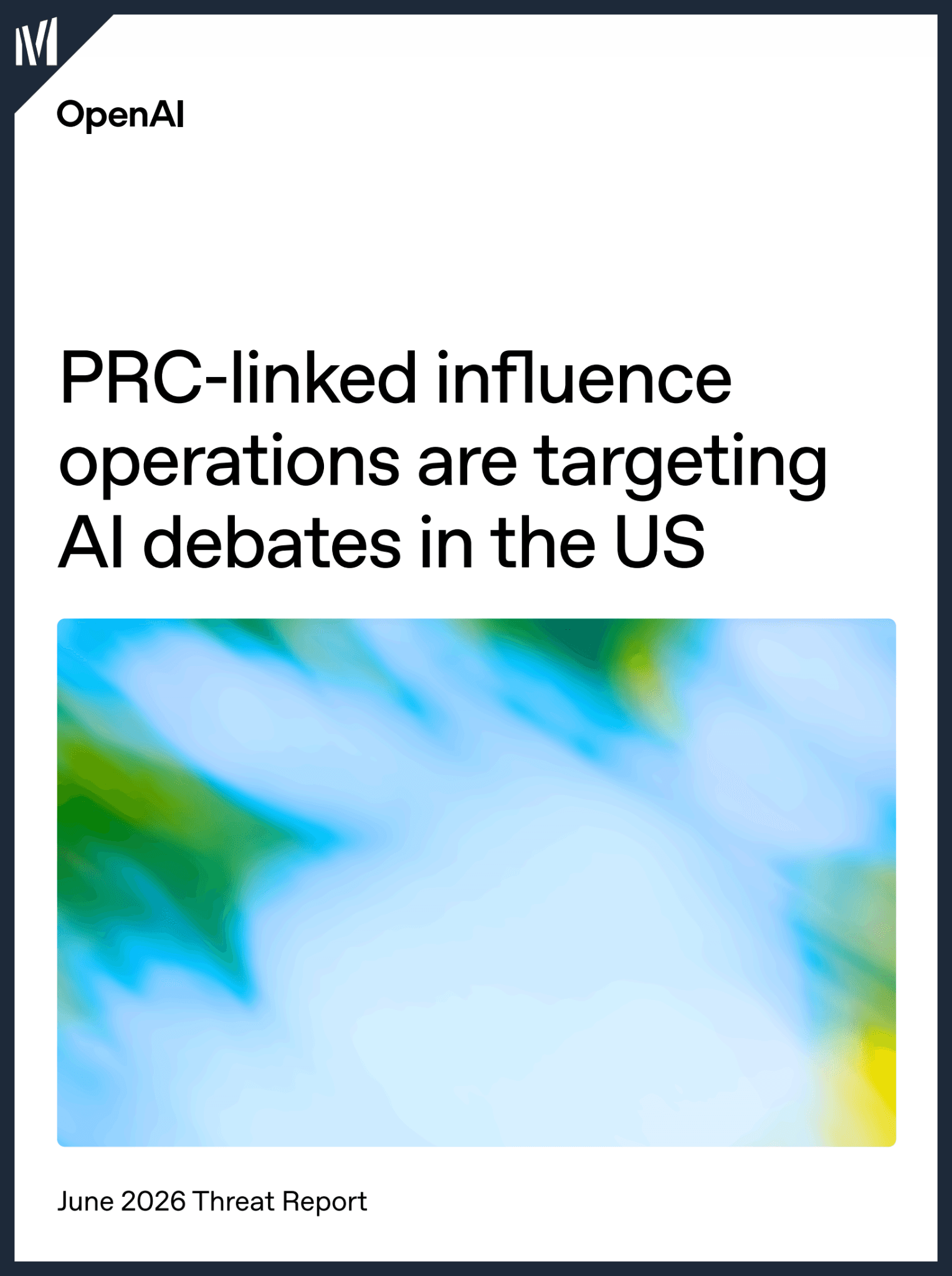
In June 2026, OpenAI published a new threat report titled “PRC-linked influence operations are targeting AI debates in the US.” The headline claim was that it found two clusters of accounts, apparently operated from China, targeting OpenAI and U.S. data center buildouts. In particular, the report identifies one cluster generating images and tweets about how data centers were increasing electricity costs for Americans, while the other posted content critical of tariffs. Connected to that second group were accounts that claimed ChatGPT user data had been compromised.
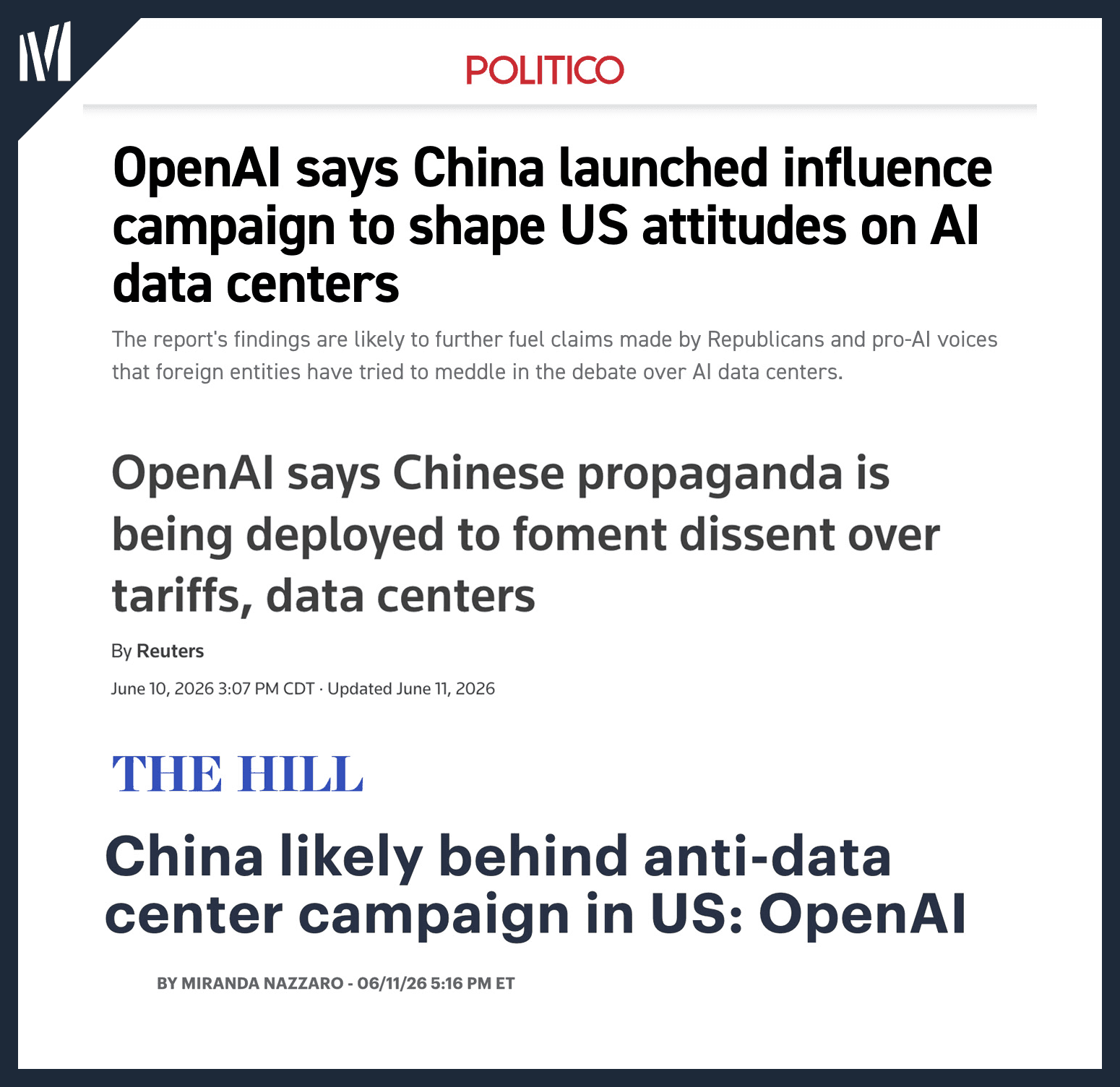
A flurry of headlines ensued. Politico reported that OpenAI had found China “launched [an] influence campaign to shape US attitudes on AI data centers,” Reuters said that “Chinese propaganda is being deployed to foment dissent,” and The Hill reported China was “likely behind anti-data center campaign in US.”
On the day of the release, the House Select Committee on China shared it in a press release. Within a month, the report had made it into a front-page New York Times story: “China, Russia and Others Seek to Inflame Debate Over A.I. Data Centers.”

Seeing these headlines, you might start to wonder just how much of the widespread data center backlash is really a psyop. But of course, the answer is virtually none, as close observers including Jordan Schneider, Molly Taft, and Andy Masley have already pointed out.
This past discussion of OpenAI’s report has raised a few important points. For one, OpenAI’s report doesn’t show a clear link to the Chinese government (which, if it wanted to run a sophisticated influence campaign, would be unlikely to use American AI services). Second, the genuine grassroots opposition to data centers in the U.S. is hard to deny at this point, and the implication that China is behind it will strain the credulity of anyone who has visited rural America. And third, OpenAI’s report admits the extremely limited reach of this effort, acknowledging that neither of the account clusters it identified “appeared to have gained much authentic engagement.”
But that raises the question: why did OpenAI pursue this report at all? Not gaining much authentic engagement may have been an understatement; in a webinar about the report hosted by the OpenAI Forum, one of the investigators admits that some of the tweets they are discussing had “maybe three views.” He speculated that one was him, one was his colleague, and one was the account operator. And, again, the report acknowledges the limited reach, saying that “[t]he targeting of OpenAI and US data center buildouts is significant not because the operation appears to have shifted public opinion, but because it shows PRC-origin influence operators testing narratives against AI infrastructure — a foundation of US technological leadership, economic growth and the broader democratic AI ecosystem.” In other words, the primary reason OpenAI found this interesting wasn’t its severity but instead its content — and specifically, its connection to AI infrastructure.
Another reason this report caught my eye is that, out of the nearly 50 detailed case studies that the OpenAI investigations team has published so far, the data center campaign is the only one that lacks an “impact” section (where OpenAI normally rates an operation’s reach/severity on their so-called Breakout Scale). It was also one of the only investigations from OpenAI’s team to get a dedicated webinar session, where OpenAI invited investigators to discuss their findings for an hour.
The interviewer hosting the session was Chris Nicholson, a member of OpenAI’s Global Affairs team, who “uses data and storytelling to document major AI use cases and support the company’s economic research.” Notably, OpenAI’s Global Affairs team handles its policy advocacy and is led by Chris Lehane. The Midas Project has previously highlighted Chris Lehane’s seemingly central role in creating Leading The Future, a super PAC funded by OpenAI’s president alongside a major OpenAI investor. Leading The Future has also been one of the more active voices promoting the narrative that data center opposition is fueled by China. The super PAC and its affiliates have consistently suggested that China is behind data center opposition in the U.S., increasingly making it a primary talking point.
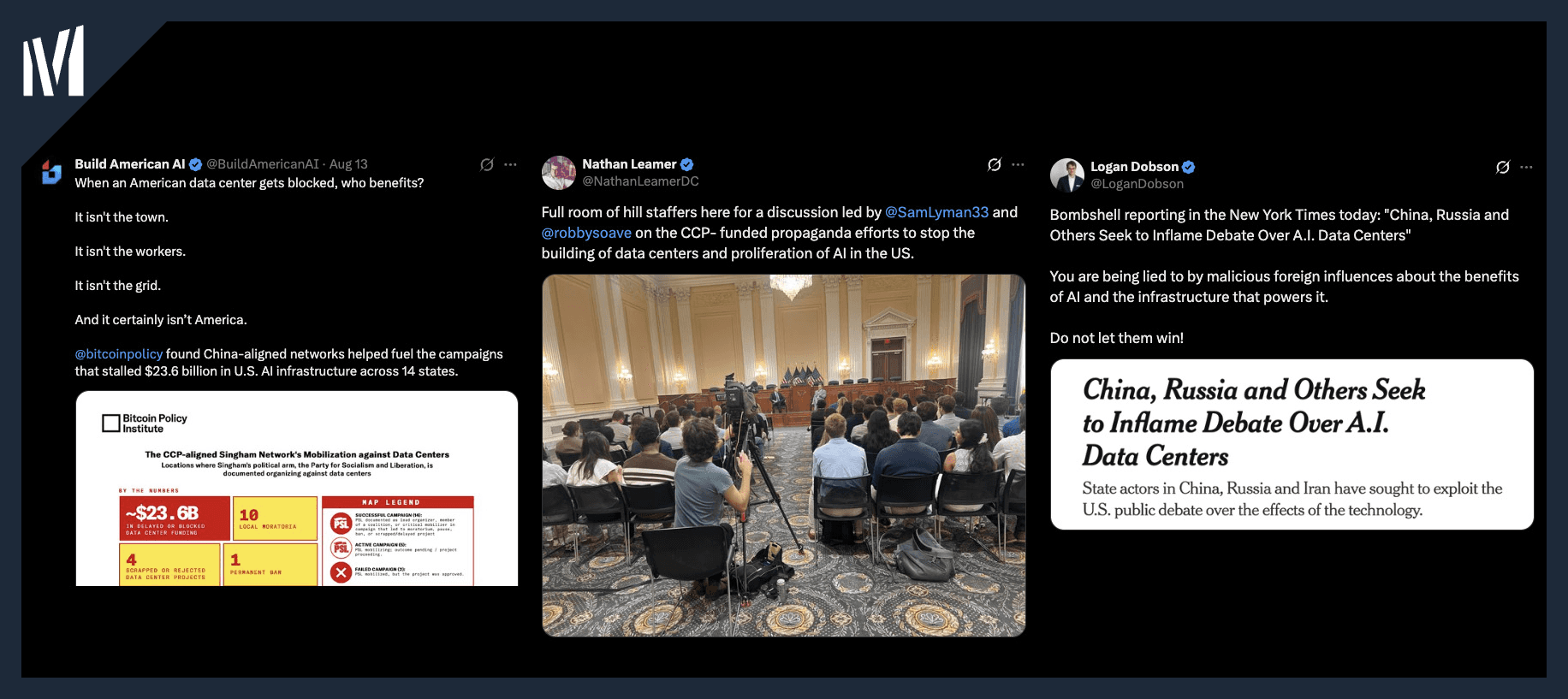
In light of this, I began to fear that OpenAI’s investigations team — at least in producing this report — was less concerned with identifying the greatest threats posed by misuse of its technology and more interested in creating narratives to support OpenAI’s policy agenda.
A recent job listing for the team adds to my concern. In late July, the company listed a new role: “Strategic Narrative and Impact Lead, Intelligence and Investigations.” The listing explains that OpenAI is looking for someone, potentially with a background in strategic communications or public policy, to work across multiple teams — primarily Intelligence and Investigations but also Communications, Global Affairs, and Policy — to help “shape the narrative around some of the most consequential questions in AI safety.”
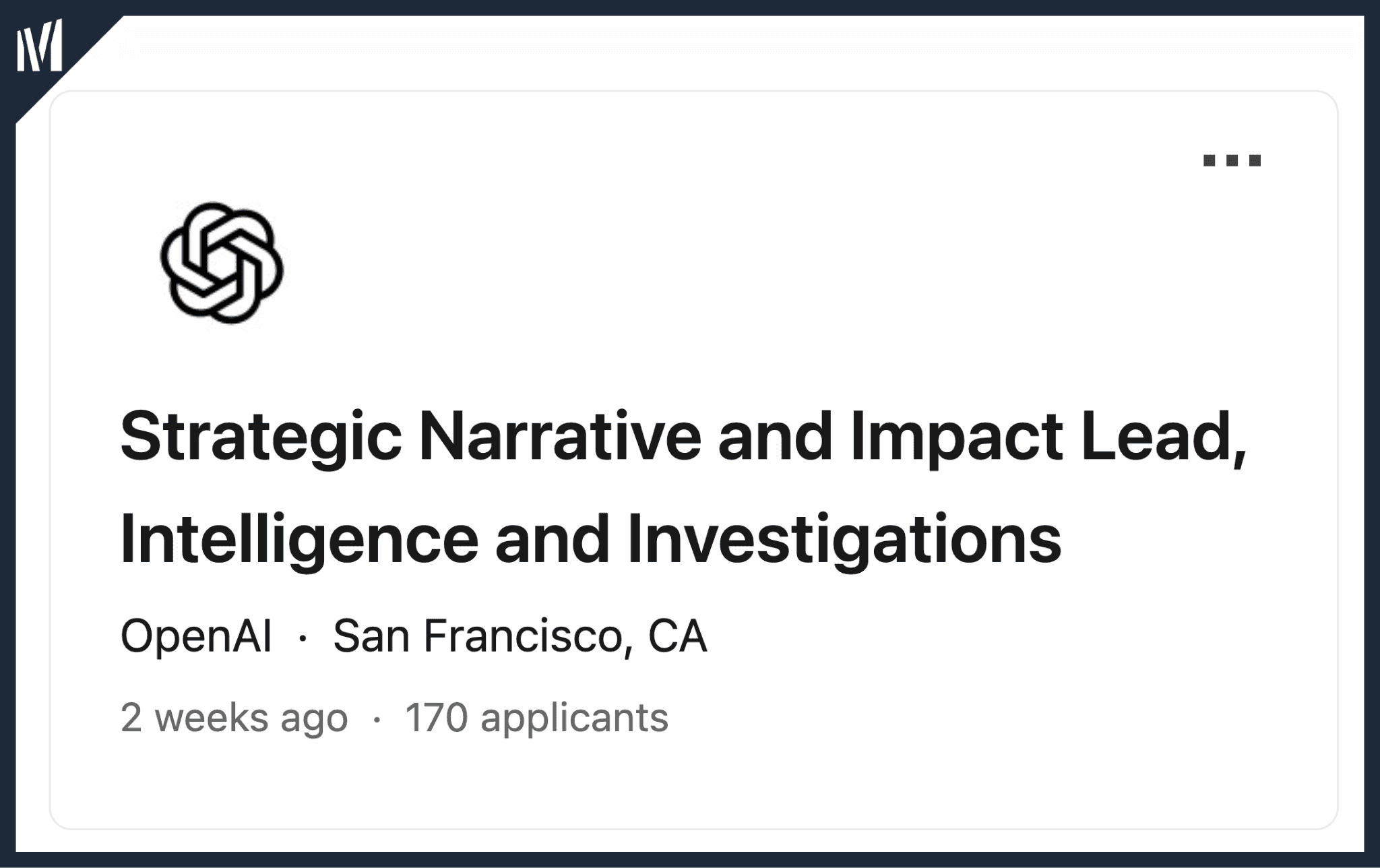
It’s possible to imagine a well-intentioned version of this role, identifying genuinely important stories from the investigations team and helping communicate them widely. But it’s also easy to imagine a version of it that uses the intelligence and investigations team as something closer to a political advocacy tool.
Economic research
Turning research into advocacy wouldn’t be unprecedented for OpenAI. In December 2025, an article from Wired described how OpenAI’s economic research team had experienced staff departures, motivated in part by a perception that the team was being treated as a de facto advocacy arm of the company. In particular, there were concerns that the company was increasingly reluctant to publish research that cast its technology in a negative light, such as work highlighting the negative impact AI could have on employment.
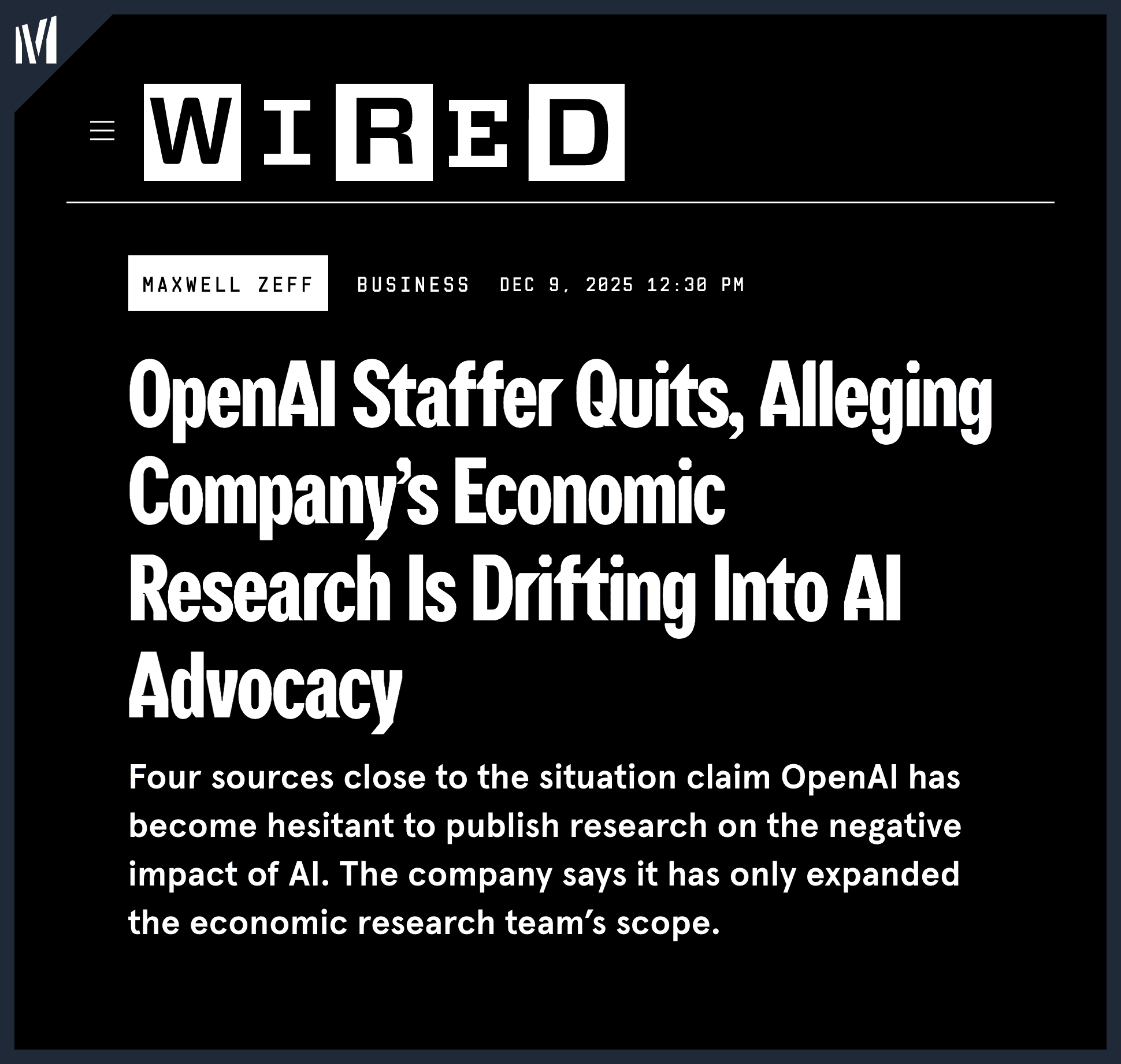
There are obvious parallels between the conflicting incentives faced by the economic research team and those faced by the intelligence team. According to the article, OpenAI’s economic research efforts are headed by Aaron Chatterji, who himself reports to Chris Lehane on the Global Affairs team.
There’s also reason to believe these conflicting incentives haven’t improved since Wired published its story last December. For example, the most recent publication from the OpenAI economic research team is a paper titled “How Organizations Use AI: Evidence from ChatGPT.” As Fortune pointed out, the paper doesn’t answer one of the biggest questions people have about the technology: how AI use affects firm performance. The authors are candid about this; they write that their estimates “should not be interpreted causally,” and call for future work linking AI usage to “measures of output, organizational change, and longer-run firm performance.”
OpenAI announced the paper in a blog post alongside a second, non-academic report called Enterprise Signals, and promoted the pair with a tweet which has been viewed nearly half a million times. Their post centers on a bold and misleading claim: “The top 10% of enterprises use plugins twice as often and skills six times as often as typical firms. These frontier firms are not ahead by accident.”
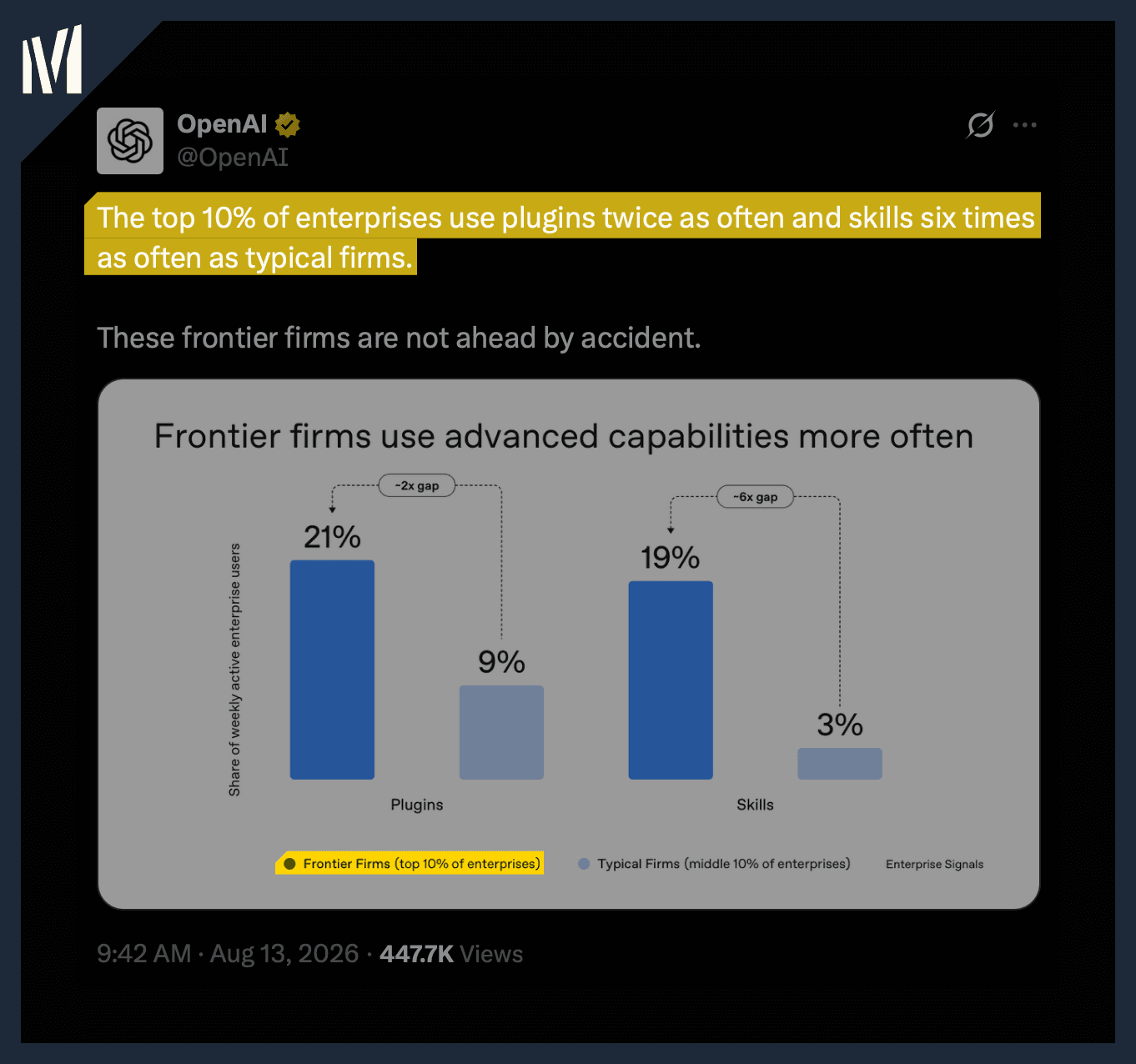
A casual reader would take this to mean that OpenAI’s researchers have found that “frontier firms,” the top 10% of companies by some meaningful measure of size, performance, or productivity, use advanced AI features far more than typical firms, and that this is why they’re ahead: “these frontier firms are not ahead by accident.”
Read the blog post, though, and you’ll learn that OpenAI defines a “frontier firm” as one that is in the top 10% of AI usage. In other words, their claim is not actually that the top 10% of firms according to any meaningful business metric are using plugins more, nor that this is causally related to their performance (as implied by “these frontier firms are not ahead by accident”), but instead that firms that use AI more also use advanced AI features more.
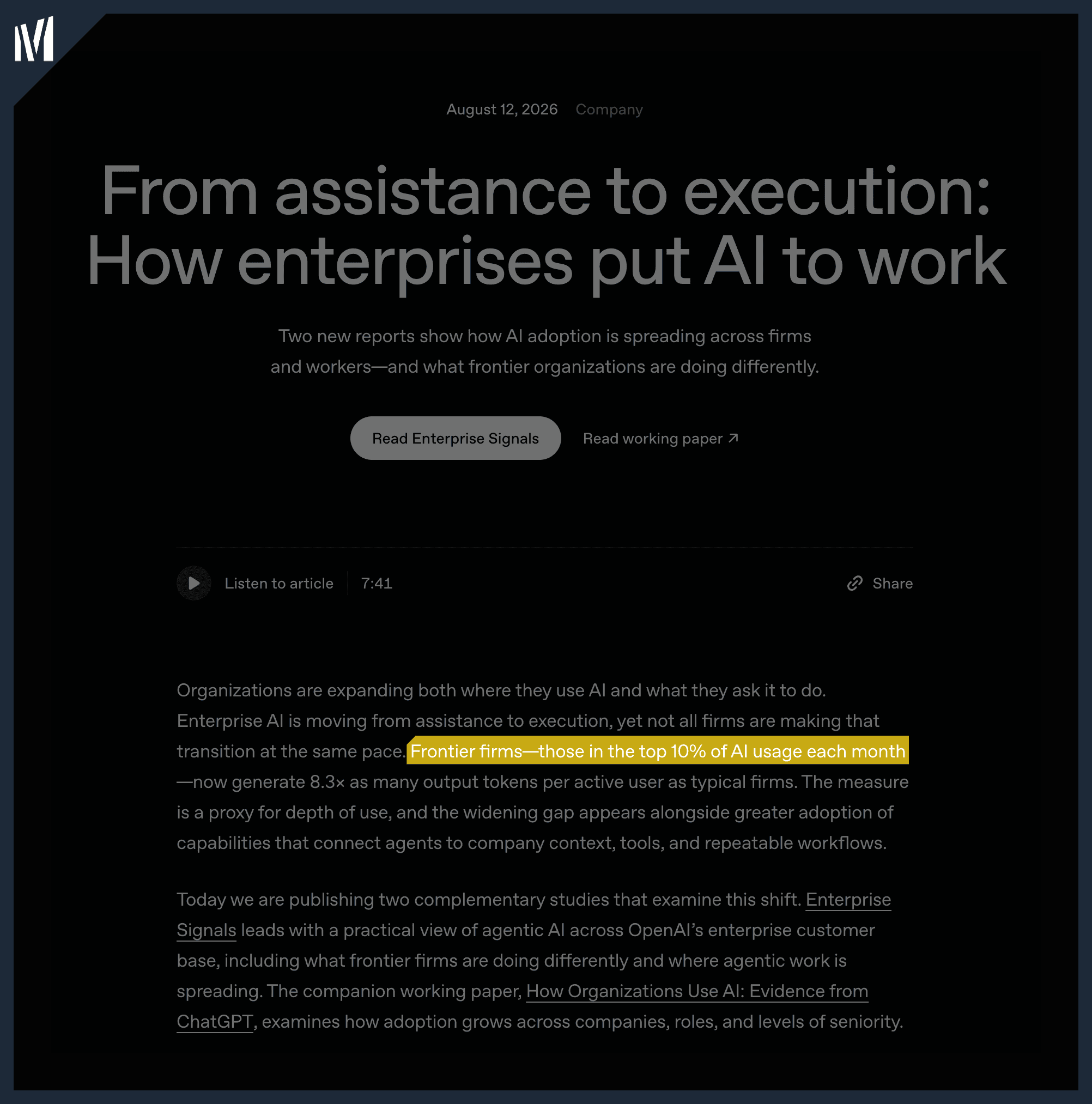
This is essentially circular reasoning. We should be very surprised if total AI usage doesn’t correlate with the frequency of use for any given AI feature. If you use 10 times more AI than another company, you probably also use AI plugins more than that company. OpenAI has taken what otherwise seems like a serious piece of economic research and presented it in misleading ways that overstate the nature and causality of the findings.
Another part of the blog post, citing the working paper, says that “enterprise adopters had stronger financial measures compared to non-adopters.” That sounds much more like the sort of evidence OpenAI were trying to advertise in their tweet… but again, the actual evidence doesn’t support the naive takeaway a reader might have. The paper intentionally makes no causal claims between AI adoption and financial success, and in fact, is mostly looking at financial performance from before the AI adoption took place. Even “adoption” itself is a binary variable representing whether a firm has created a ChatGPT Enterprise account, which the authors acknowledge doesn’t mean non-adopters aren’t using AI (since they could be using the OpenAI API, competitors’ enterprise offerings, open-source models, or individual ChatGPT accounts). Making matters worse, the “stronger financial measures” are mostly proxies for size: how much in assets a firm holds, how many workers it employs, and how much it spends on R&D. The paper’s own summary is that adopters are “larger, more capitalized, more valuable, and more R&D-intensive” than the average public firm. But it seems unsurprising that the largest companies would, at some point in time and somewhere across the organization, sign up for any given software service.
Child safety research
If there’s one area where you’d expect OpenAI to be incentivized to produce careful, factual work, it’s child safety. It’s the most emotionally charged question in AI policy right now, and it’s the subject of active litigation targeting OpenAI, including a recent lawsuit from the Florida attorney general.
In April 2026, the company published “Protecting Children in the Age of Generative AI,” a policy blueprint laying out recommendations for providers and policymakers. It’s a serious-looking document that purports to contain OpenAI’s best ideas for preventing child exploitation.

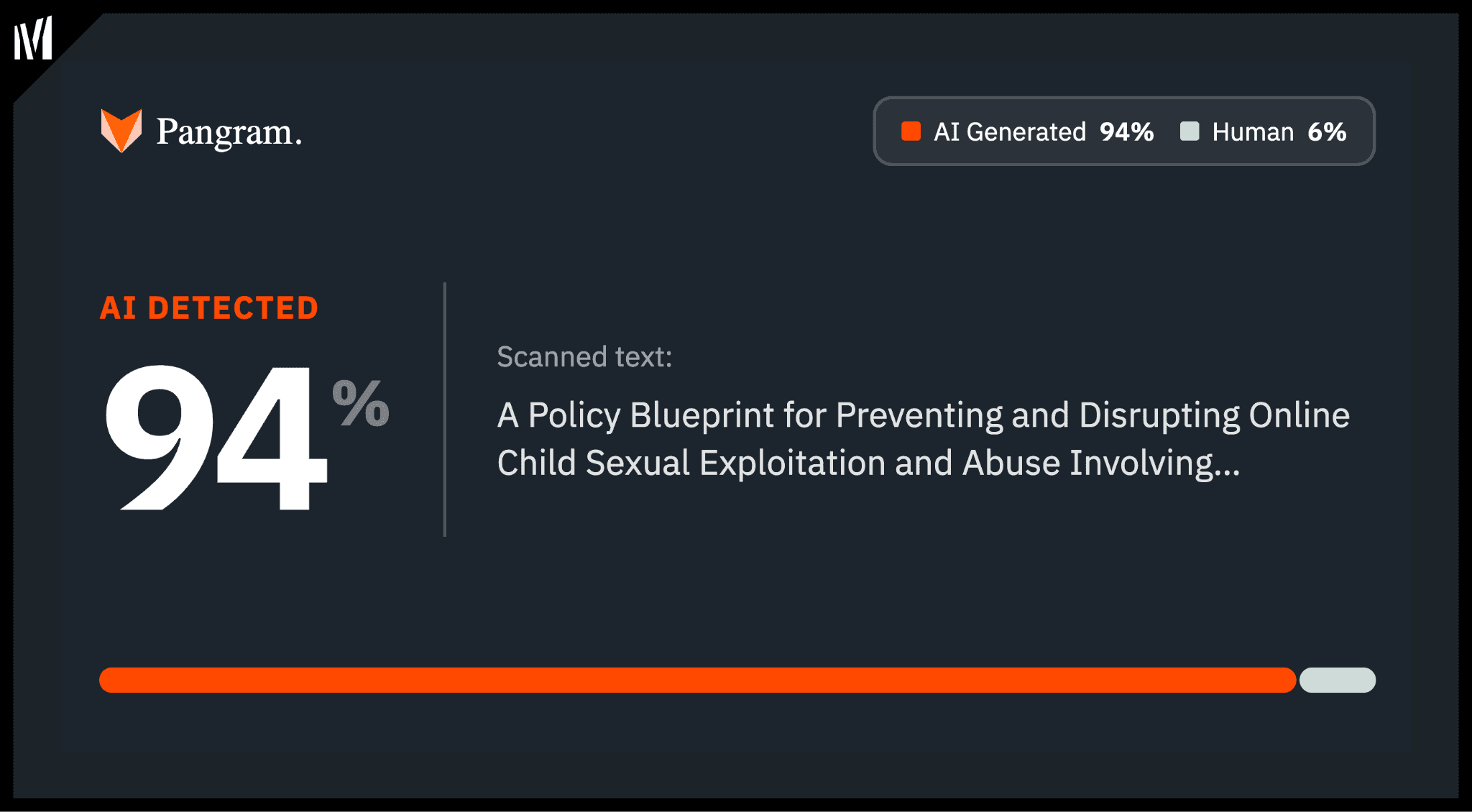
According to Pangram, 94% of the document, excluding some testimonials at the beginning, is AI-generated. When I wrote about Anthropic’s AI-generated training data disclosure, I shared my thoughts on what we can take away from a finding like this: it’s not that an AI company (or any company for that matter) using AI to write copy is inherently surprising, nor bad in and of itself, but it is concerning when this is correlated with reduced quality and seriousness underlying the creation of the text. In most cases, a carefully considered policy document will be difficult or impossible to produce while trusting AI to write the copy (especially since, in my own testing, even moderate editing of the text tends to remove Pangram’s classification).
This problem extends even beyond OpenAI’s own publications. Ten days after this blueprint was published, OpenAI posted on X and LinkedIn to promote the fact that it had received the best score on something called the TeenAegis AI Model Danger Index, indicating that its models were safer for teens than all other AI companies’ models. At the time, Pangram flagged 44% of the index as AI-generated, including the entire section evaluating OpenAI (the current version scores 96% AI-generated).
The index evaluates ten AI companies on teen safety, but the stated methodology is extremely vague. TeenAegis said the scores are produced by something called the “Teen Accountability Intelligence Matrix,” using a “proprietary multi-domain weighting methodology,” and that they’re “updated every 5 minutes.”
The errors are what you’d expect from a document generated rather than written. For example, at the time, the index listed Claude as having a minimum age of 13, but in reality, Anthropic’s cutoff is 18. It also attributed multiple investigations to the wrong organization. It incorrectly described a settlement reached with Meta as a Children’s Online Privacy Protection Act settlement, which it wasn’t. And, perhaps most importantly, the index got OpenAI’s own history wrong. With regard to teen self-harm linked to ChatGPT, the index said there was “[o]ne documented Senate hearing incident (September 2025) in which a father testified ChatGPT contributed to his teen’s suicide — a single incident, not a pattern.” It is technically true that this was a single testimony, but it is not remotely true that ChatGPT was only linked to a single suicide.
Taken together, these errors suggest that OpenAI is viewing child safety through a cynical lens, hoping to protect its reputation and advance light-touch policies while appearing to engage substantively with the issue. This would be consistent with reporting from The San Francisco Standard (released a week before OpenAI’s AI-generated policy blueprint came out) that OpenAI had discreetly astroturfed a child safety coalition to help advance its policy agenda.
Looking forward
Every day, OpenAI’s research function is becoming more important. The company has brought us into a new era of AI-enabled cyber threats, and we are now genuinely in uncharted waters. Following the Hugging Face incident, it commissioned a third-party assessment from METR and Redwood Research to identify what went wrong and, hopefully, help strengthen the ecosystem moving forward. It announced that a blog post would describe the scope of this engagement, but no such post has materialized yet.
As The Midas Project has pointed out, OpenAI has already framed this incident in ways that look less like a mistake and more like an accomplishment. As it writes about this incident and future ones, OpenAI will face increased pressure to package its research in ways that are less about finding the truth and more about advancing its political and reputational goals.
Hopefully, the organization will muster the courage to resist that impulse.

A pro-AI, dark-money group tied to David Sacks appears linked to a new astroturfing campaign

SpaceXAI just released Grok 4.5. It may have broken California’s AI law in the process.

A Pro-AI Super PAC's Secret Meme Sockpuppets
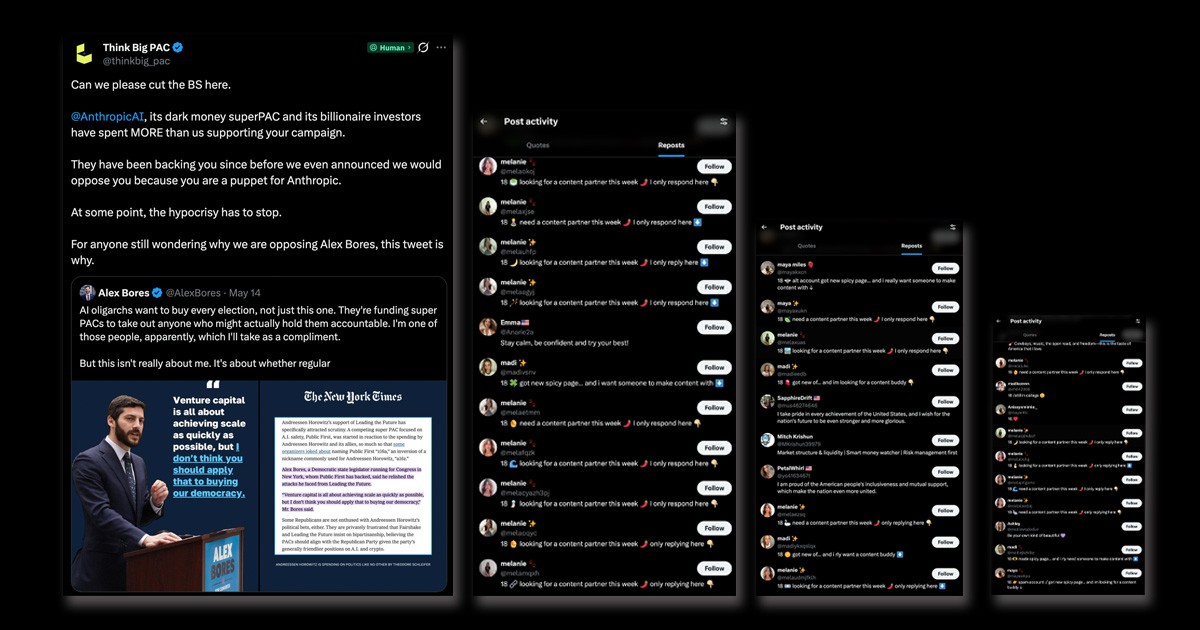
Is OpenAI’s super PAC paying for an army of Twitter bots to engage with their content?
This will hide itself!